
The Indian government is unlikely to allow a parliamentary debate on the West Asia crisis, citing prior briefings by the External Affairs Minister. This decision comes amid opposition protests and a pending no-confidence motion against the Speaker.

Pakistan, Turkiye, and Saudi Arabia have signed a trilateral defence pact, agreeing to treat an attack on one as an attack on all. Analysts suggest this alliance could significantly diminish the United States' strategic influence in West Asia and elevate Pakistan's geopolitical standing, potentially acting as a deterrent in regional conflicts.

Prime Minister Narendra Modi has called for the resolution of the West Asia crisis and the Ukraine conflict through dialogue and diplomacy, asserting that military action alone cannot achieve lasting peace. He made the remarks after talks with Norwegian Prime Minister Jonas Gahr Store.

Indian benchmark indices Sensex and Nifty saw a significant rebound in early trade, driven by a sharp decline in crude oil prices and easing geopolitical tensions in the West Asia, which improved market sentiment and reduced inflation fears. Track Sensex, Nifty on July 27.

A prolonged supply shock can transmit to lower incomes, and dampen confidence and sentiment, warns Aditi Nayar, chief economist, head-research and outreach, ICRA.
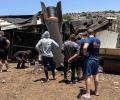
India addresses the escalating conflict in West Asia, outlining its diplomatic efforts to ensure energy security, the safety of its citizens, and advocating for a peaceful resolution through dialogue.

Moody's Ratings has highlighted that Indian banks are among the most exposed in the Asia-Pacific region to the West Asia crisis, primarily due to India's high dependence on energy imports, which could lead to increased inflation, higher interest rates, and strained borrower cash flows.

Indian benchmark indices, Sensex and Nifty, saw declines in early trade due to escalating crude oil prices and ongoing US-Iran hostilities, which subdued investor risk appetite.
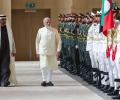
Prime Minister Narendra Modi has offered India's support to bring peace to West Asia during talks with UAE President Sheikh Mohamed bin Zayed Al Nahyan. Both countries signed agreements to strengthen strategic collaborations in energy and defence.

Union Finance Minister Nirmala Sitharaman has warned that the ongoing West Asia crisis is not merely a geopolitical issue but will directly lead to higher fuel costs for common people and businesses, impacting shipping, input availability, and export orders.

Indian equity benchmark indices Sensex and Nifty rallied in early trade, driven by reports of a second round of talks between the US and Iran, which are fostering hopes for a resolution to the West Asia conflict, coupled with Brent crude oil prices trading below the USD 100 per barrel mark.

Indian benchmark indices Sensex and Nifty experienced a significant slump in early trade, mirroring weak global trends, as escalating tensions in West Asia, particularly a drone attack on the UAE's Barakah nuclear facility, pushed crude oil prices higher. Track Sensex, Nifty50 movement and key market drivers for May 18, 2026.

The Ministry of External Affairs (MEA) has stated that Prime Minister Narendra Modi and External Affairs Minister S Jaishankar are actively engaged with world leaders to promote dialogue and diplomacy for peace in West Asia, while also ensuring the safety and well-being of the Indian community in the region.
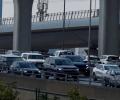
Foreign Ministers from Saudi Arabia, Egypt, and Turkiye convene in Pakistan for a summit aimed at de-escalating the ongoing conflict in West Asia, with Pakistan actively seeking to broker peace through dialogue and diplomacy.

Prime Minister Narendra Modi and French President Emmanuel Macron discussed the escalating situation in West Asia, emphasising the need for dialogue and diplomacy to restore peace and stability in the region.

Precious metal prices, particularly gold and silver, experienced a significant surge in the national capital as investors sought safe-haven assets amid escalating hostilities in the Middle East.

Pakistan's Foreign Minister Ishaq Dar has called for dialogue to address the ongoing conflict in West Asia, emphasising the importance of diplomatic engagement and sustained efforts to promote peace and stability in the region.

Asian Development Bank (ADB) on Friday warned that India's limited crude oil reserves of about 100 million barrels - sufficient for only 40-45 days of consumption - leave the country particularly vulnerable to supply disruptions through the Strait of Hormuz amid the ongoing war in West Asia.

Fuel prices have risen by about Rs 7.5 per litre since May 15, as global crude oil prices surged due to the ongoing conflict in West Asia and supply concerns around the Strait of Hormuz.
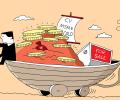
Several non-banking financial companies (NBFCs) are observing an increase in early-stage delinquencies within their micro, small and medium enterprises (MSME) loan portfolios, primarily driven by supply chain disruptions and escalating raw material costs exacerbated by the ongoing conflict in West Asia.

Prime Minister Narendra Modi and French President Emmanuel Macron discussed the escalating situation in West Asia, emphasising the importance of dialogue and diplomacy to restore peace and stability in the region.

Despite geopolitical tensions and FII outflows, Indian small and midcap stocks have not only recovered losses but are also outperforming largecap indices, driven by attractive valuations, domestic institutional support, and a rebound in earnings.

The Ministry of External Affairs (MEA) has confirmed the deaths of six Indian nationals and one missing person amidst the escalating conflict in West Asia, detailing ongoing efforts for repatriation and diplomatic engagement.

Remittances from West Asia in March rose sharply amid the conflict in the region, with industry insiders estimating inflows to be 20-30 per cent higher than what is usual in a month.

Indian benchmark indices, Sensex and Nifty, extended their losses for a second consecutive day, primarily due to HDFC Bank's disappointing quarterly earnings and escalating tensions in West Asia, coupled with persistent foreign fund outflows.
Crude oil prices reached a new record high in futures trade, both domestically and internationally, as escalating military tensions between the US and Iran in West Asia continue to fuel market volatility. Diplomatic efforts concerning the Strait of Hormuz are being closely watched for potential price stabilisation.

A recently finalised peace deal between the US and Iran, set to be signed on June 19, is expected to significantly benefit India's economy by boosting exports to West Asia, stabilising the rupee, and easing inflationary pressures, according to exporters and experts.

Indian benchmark indices, Sensex and Nifty, continued their downward trend for the fifth consecutive day, with the Sensex dropping 281 points and Nifty falling 78 points, primarily driven by surging crude oil prices and persistent geopolitical tensions in West Asia.

The Indian government has convened an all-party meeting to discuss the ongoing crisis in West Asia, following Prime Minister Modi's address to Parliament on the situation and its potential impact on India.

Amidst escalating tensions in West Asia, India voices strong concerns over the safety of its nationals and the potential disruption to energy supplies, urging dialogue and diplomacy for a swift resolution.

Pakistan's Foreign Minister Ishaq Dar met with his counterparts from Egypt and Turkiye in Islamabad ahead of a quadrilateral summit, including Saudi Arabia, to discuss the ongoing conflict in West Asia and explore avenues for peace.
Pakistan is set to host a quadrilateral summit of foreign ministers from Saudi Arabia, Egypt, and Turkiye to discuss the ongoing conflict in West Asia and explore avenues for peace negotiations.

Sri Lanka has established emergency hotlines and is closely monitoring the situation in West Asia following escalating tensions, urging restraint and de-escalation from all parties involved.
India has expressed serious concerns about the West Asia crisis and its potential impact on energy supplies and maritime stability, urging BRICS nations to find practical solutions to geopolitical challenges and unilateral sanctions.

Prime Minister Narendra Modi addressed the Lok Sabha on the West Asia crisis, expressing concern over its impact on the global economy and assuring the safety of Indian citizens in the region.
Prime Minister Narendra Modi addressed the Lok Sabha on the West Asia crisis, expressing concern over its impact on the global economy and assuring the safety of Indian citizens in the region.

The 'Finalissima' match between Spain and Argentina that was scheduled to be held in Qatar has been cancelled due to the conflict in the Middle East while the South American side rejected multiple alternatives, UEFA said on Sunday.
Prime Minister Narendra Modi addresses the Rajya Sabha, detailing India's strategies to navigate the global energy crisis sparked by the West Asia conflict, including securing diverse energy sources and expanding strategic oil reserves.

Karnataka Deputy Chief Minister D K Shivakumar has urged the central government to protect Indians, especially Kannadigas, stranded in West Asia due to the ongoing conflict, assuring that all efforts are being made to ensure their safety.

Closely watched by the world for any escalation, the Iran-Israel conflict is already showing early signs of stress for India Inc - longer deliveries, doubling freight rates, extended working capital cycles, and higher costs. For those yet to feel the heat, there is growing apprehension and nervousness over future developments, observed industry executives.
